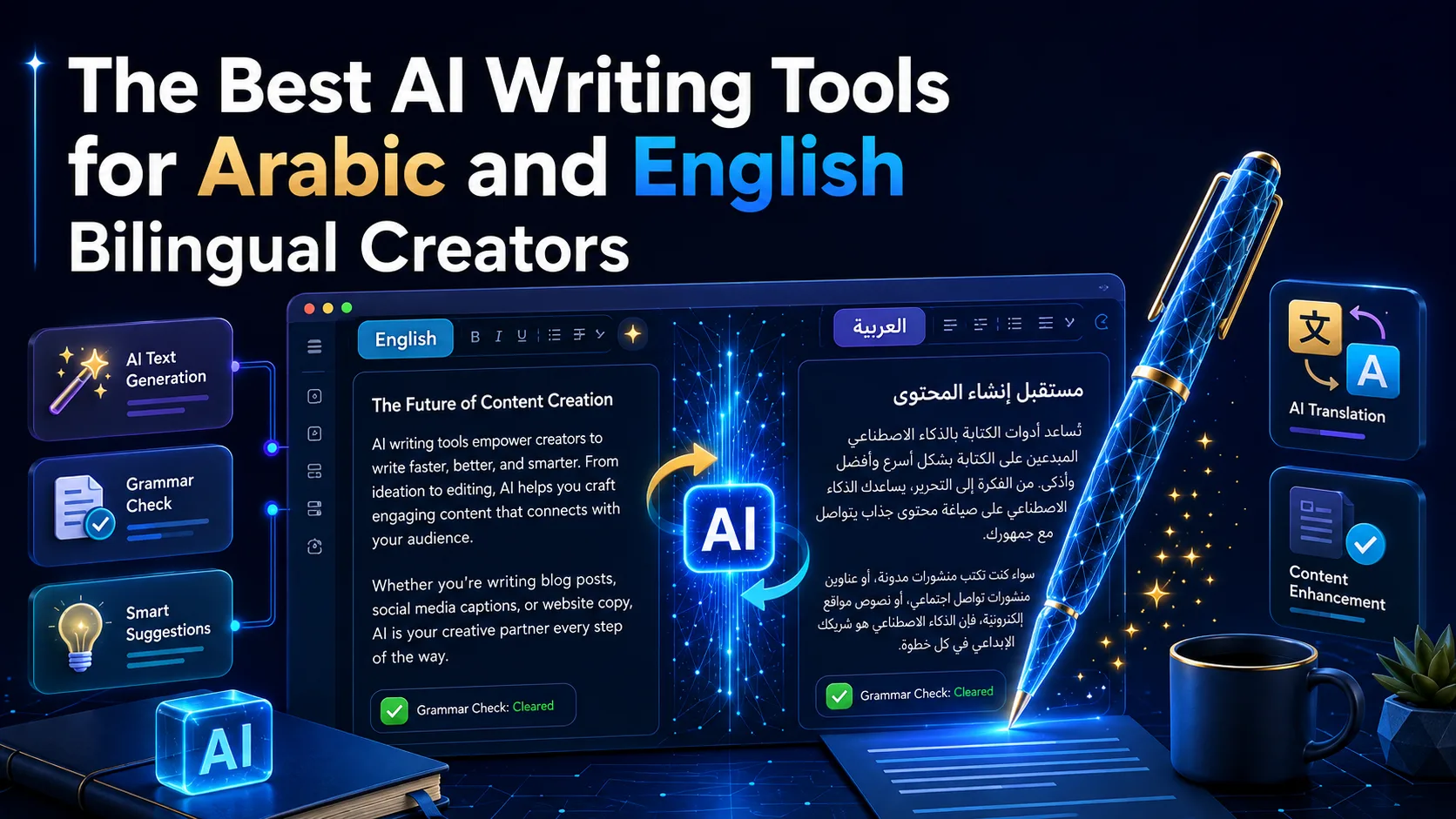
Discover the top AI-powered writing assistants that seamlessly handle both Arabic and English, helping bilingual creators streamline their workflow and maintain high-quality content.
Introduction: The Unique Challenges of Bilingual Content Creation
Bilingual creators working in both Arabic and English face a unique set of challenges that go far beyond simple translation. While English dominates the landscape of modern technology and AI development, Arabic features a rich grammatical structure, diverse cultural nuances, and a Right-to-Left (RTL) script. Finding a single AI tool that excels in both worlds is essential for maintaining productivity without sacrificing quality.
In this guide, we will explore the best AI writing assistants that effectively bridge the gap between Arabic and English. We will focus on tools that do not just translate literally, but actually help you generate creative ideas, refine your tone, and adapt your message to suit different cultural audiences seamlessly.
Key Features to Look For in Bilingual AI Tools
When selecting an AI writing tool for a bilingual workflow, several key features deserve your attention. First and foremost is robust Right-to-Left (RTL) support. Without proper RTL formatting, editing Arabic text can become a frustrating experience, with punctuation marks and English loanwords jumping to the wrong sides of the screen.
Secondly, the tool must possess advanced Natural Language Processing (NLP) capabilities in both languages. It should understand the contextual differences, idioms, and stylistic variations between formal Arabic (MSA) and modern English, ensuring that the generated outputs sound natural and professional to native speakers of both languages.
Top AI Writing Tools Evaluated for Bilingual Creators
Jasper AI stands out as a premier choice for professional creators, thanks to its integration of advanced language models that generate high-quality marketing copy in both Arabic and English. It offers tailored templates for blog posts, social media ads, and emails, allowing users to easily adjust the tone of voice to match their target audience's cultural expectations.
Copy.ai is another excellent option, particularly for creators who value a clean user interface and rapid workflow. It supports Arabic generation quite well and excels at brainstorming blog outlines and social media captions, saving creators hours of staring at a blank page.
Finally, OpenAI's ChatGPT remains the most versatile and powerful tool on the market. With continuous updates to its GPT models, it has developed an impressive grasp of complex Arabic sentence structures and poetic expressions, making it an invaluable asset for creative translation and cross-lingual content adaptation.
Best Practices for a Seamless Bilingual AI Workflow
To get the most out of these AI tools, we recommend a workflow focused on direct generation rather than direct translation. Instead of writing an article in English and translating it to Arabic, feed the core concepts and outlines to the AI and ask it to generate the content natively in each language. This ensures the flow remains natural and culturally relevant.
Always remember that AI is an assistant, not a replacement for your unique voice. Always review the generated Arabic text to eliminate any awkward phrasing that reads like a literal translation from English, and ensure that technical terminology is localized correctly for your specific target audience.
Comparison table
Tool | Arabic Support | English Support | Best Use Case |
|---|---|---|---|
Jasper AI | Excellent (via advanced models) | Excellent | Professional marketing copy and long-form blogs |
Copy.ai | Very Good | Excellent | Social media posts and quick brainstorming |
ChatGPT | Excellent (highly flexible) | Excellent | Creative translation, essay writing, and ideation |
Rytr | Good (straightforward) | Very Good | Short-form content and emails on a budget |
Frequently asked questions
Do these AI tools support regional Arabic dialects?
Most advanced models like ChatGPT can understand and generate popular regional dialects (such as Egyptian or Levantine) when explicitly prompted. However, they perform best and write most accurately in Modern Standard Arabic (MSA).
How can I prevent AI-generated Arabic from sounding robotic?
To avoid a robotic tone, do not rely on direct translation prompts. Instead, ask the AI to write a fresh draft based on key bullet points, and always perform a manual edit to inject your personal style and local idioms.
Are there free AI writing options available for bilingual writers?
Yes, ChatGPT offers a highly capable free tier that handles both languages exceptionally well. Tools like Copy.ai and Rytr also offer limited free plans or trials so you can test their multilingual capabilities before committing to a subscription.
Comments
Be the first to comment.